I have a cravings for good whiskey, and this fact will not change in near future. However, what is the most important for me is the taste, story (and price) of alcohol. After coming back to Japan, I am more obsessed about shochu (焼酎) for its good taste, passion of shochu distillery and affordable price. Normally, a bottle of Shochu (700-750 mL) costs under 1000 yen(about $9) in Japan, and Shochu with the cost of 2000 yen ($18) is regarded as “expensive” one. Despite of its affordable price, we can enjoy the different taste between distilleries, and most importantly, THE TASTE OF SHOCHU IS GREAT!
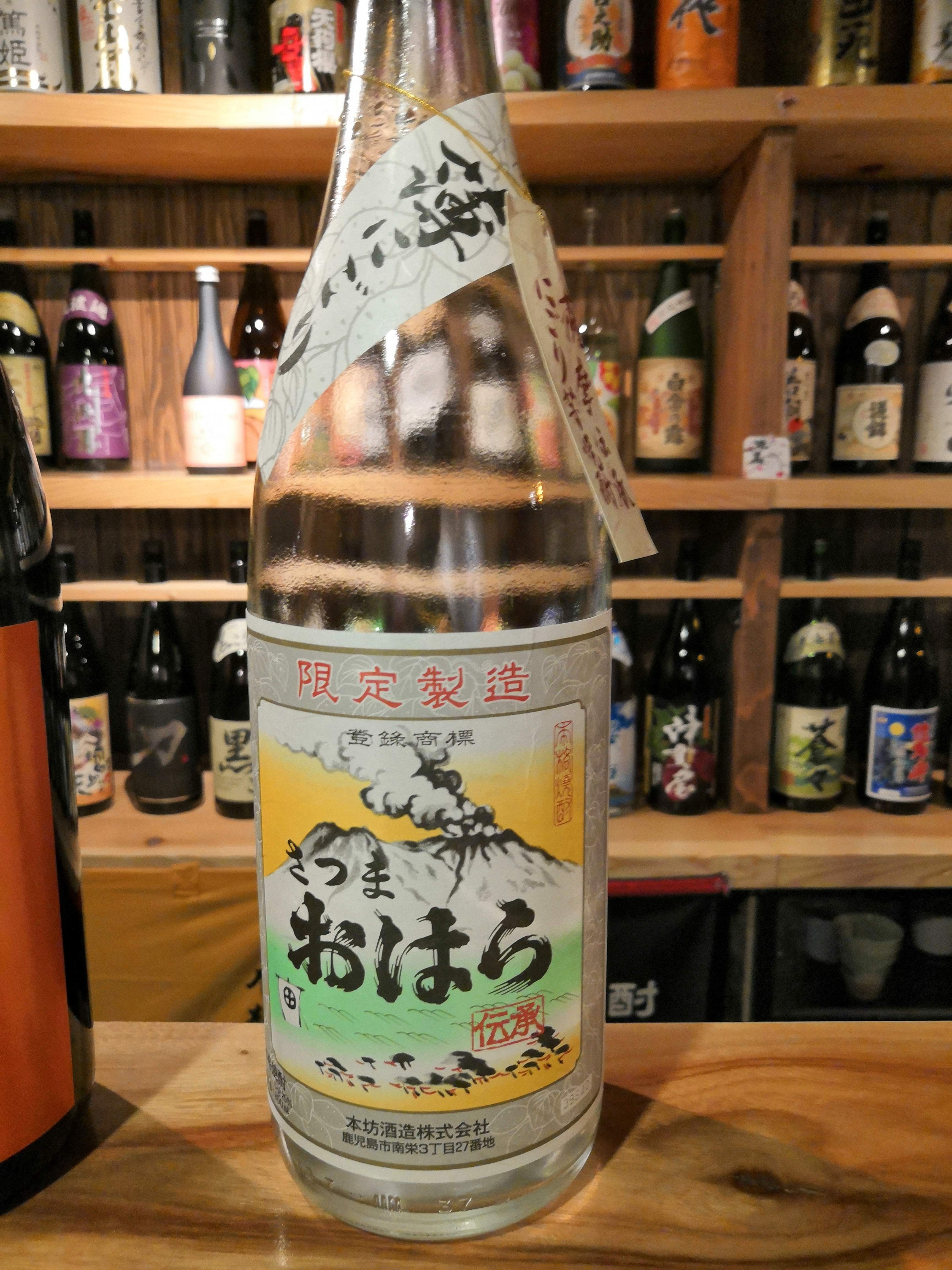
As explained in the last post, shochu is a distilled alcohol made from rice, barley, etc. It’s like whiskey, brandy or ram. Actually, more than 50 ingredients are permitted by Japanese government as ingredients for Shochu (authentic shochu has such restriction for ingredients, every ingredients are permitted for other type of shochu), and the number of permitted ingredients are increasing every year.
In this post, You will learn the things like : (sorry, but 5 and 6 are to be written next time!)
- History
- Definition of Shochu(焼酎)
- The use of Koji-kin (麹菌: mold)
- Manufacturing process
- Koji making
- Ichiji-Shikomi (first preparation)
- Niji-Shikomi (second preparation)
- Distillation
- Storing/Aging
- Productisation
- Taste of Shochu and factors for its taste
- Shochu with various ingredients
1. History of Shochu
In comparison to fermented alcohol, the history of distilled alcohol is short. This is because it needs the technique for distillation.
China might be the first country which enjoyed distilled alcohol. Distilled alcohol in China has been known since at least 13th century.
A still is invented around 3000 B.C. in Mesopotamian period, however, distilled alcohol has been regarded as a medicine in Europe until 16th century. From Mesopotamia, a still was spread out to the world, as it was important for alchemy.
Shochu is said to have came from Thailand to Okinawa, a southern island of Japan around 14th Century. Some believe that it came from Korea to Iki island, a small island in Nagasaki prefecture, Japan as a form of Koryo liquor. (Iki is also famous for Iki-Shochu, and it is one of four Shochus listed in GI, Geographical indication. Scotch whiskey is also listed in GI).
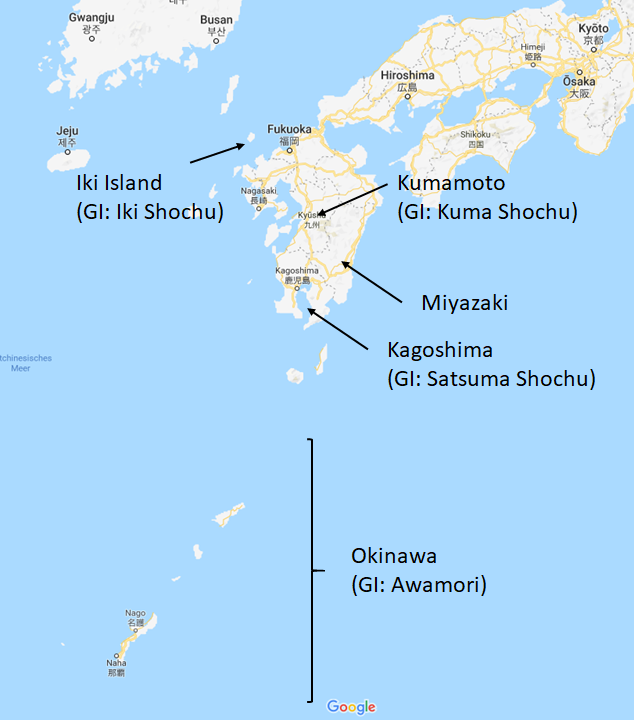
It is said that shochu arrived at Kagoshima around 16th century, and after that, it was spread to Kumamoto and Miyazaki. Around 17th century, people started making Shochu with local ingredients in each region. Issho-bin(一升瓶), a large 1.8 liter bottle for Sake or Shochu, became popular around 1910-1930.
2. Definition of shochu
There are some kinds of shochus including koshu shochu(甲種焼酎, lit. class A shochu) and otsushu shoshu(乙種焼酎, lit. class B shochu). Actually, otsushu shochu(class B) is more dedicated one than koshu shochu(class A), and koshu shochu is produced with automated process. In the world of shochu, class A or B is just for classification, and not for the quality. There is honkaku shochu(本格焼酎, lit. authentic shochu) as well, in the category of otsushu shochu.
- Koshu shochu (甲種焼酎, lit. class A shochu)
- Normally, molasses or date palm are used as an ingredient (Ingredient of Otsushu/Honkaku shochu is much better!)
- Patent still
- gives smoother taste with less smell from ingredients
- more efficient to get higher amount of alcohol
- good for mass production
- By adding water into distillate, alcohol content of koshu shochu should be diluted to be under 36 %
- Otsushu shochu (乙種焼酎, lit. class B shochu)
- Despite of its name, it is more authentic, and thought to be better than Koshu shochu(甲種焼酎)
- Alcohol content of otsushu shochu should be under 45 %, adding water into distillate
- Single distillation(Pot still)
- gives shochu more flavours and tastes from ingredients
- Honkaku shochu (本格焼酎, lit. authentic shochu)
- Again, class B of otsushu shochu does not reflect the fact that Otsuchu shochu is better than Koshu shochu, which is literally translated into “class A”.
- Therefore, shochu makers proposed otsushu shochu to be called as honkaku shoshu (authentic shochu). Later on, the government approved the proposal, and the government gave criteria for shochu being called as “authentic shochu(honkaku shochu)”.
- The ingredients are restricted to about 53, which are approved by the director general of national tax agency of Japan. Moreover, additives except water are not allowed to use.
- Alcohol making is very related to the tax in Japan, as the tax used to account one-third of total tax revenue of Japanese government in 1899.
- Now, it occupies only 2.2 % of total tax revenue as of 2017, however, tax agency still want to regulate 😦
- Therefore, unlike other countries, tax agency often regulate sake, shochu, or other alcohol.
- Rice, potato, rice, barley, sake kasu (leftover bits from sake making process), brown sugar are the popular ingredients among approx. 53 ingredients.
- Malt, or other sprouted grains should not be used, to distinguish from whiskey
- Ash of birch should not be used for filtration, to distinguish from vodka.
- Juniper berries should not be added, to distinguish from gin.
- Fruits, except date palm should not be used, to distinguish from brandy.
- Sugar-contained materials, including sugar, honey, maple syrup should not be used, to distinguish from rum.
- However, black suger shochu (Kokuto shochu) are allowed to be “honkaku shochu” if it is made within Amami islands in Kagoshuma and kome koji (rice Koji; explained later on), for cultural reason
3. The use of Koji-kin(麹菌: mold)
One of the special thing about shochu is the use of mold called Koji-kin. Barley is sprouted to make a molt when making a whiskey or beer. Molt has an enzyme for degradation of a starch(a big molecule) into glucose(a smaller molecule). Yeast can only process glucose to produce alcohol.
For degradation, Koji-kin, or mold is used in Shochu production. Mold can also degrade the starch in a barley. The usage of mold is necessary for Japanese food culture, although in Europe, it was not so popular, except for blue cheese. In Japan or other Asian countries, due to its humid weather, it has been easy to get moldy. Therefore, there are lots of foods which use mold in Asia. Soy sauce(醤油) or Miso(味噌), basic seasoning for Japanese cuisine, comes from Daizu-Koji(大豆麹, Mold is breed in soy).
Japanese Koji (barley, rice, etc. covered with Koji-kin: mold) is a bit different from other Asian countries. In Japan, mold is breed in each individual grain of cereals. This type of Koji utilized in Japan is called バラ麹(Bara-Koji: separated Koji), and only one kind of mold (more scientifically, Aspergillus species) is used. In China, Indonesia, Philippines and Thailand, barley or rice are crashed, and then the mold (mainly Rhizopus species) is spread out into its surface and breed. This kind of Koji is called mochi-Koji(餅麹).

(From the website of Gekkeikan: http://www.gekkeikan.co.jp/enjoy/industry/world/world03.html)


These mold has a proteolytic enzyme which decomposes protein, in addition to amylase, which decomposes starch. Proteolytic enzyme produces amino acids and peptide, which contributes to the taste.
Following environment is required for breeding of mold.
- water, oxygen, temperature, acid environment (but close to pH 7; mold can be bred in wide range of pH, though)
- Nutrition for mold
- carbon (starch, glucose, etc. )
- nitrogen (amino acid, ammonium nitrate, etc. )
- mineral (P, K, Fe, Mg, Cu, Zn, Mn)
Three different types of Koji-Kin are used for production of Shochu or Sake, as shown below.
| Scientific name (IRBN) | Note of Shochu made with each Koji | used for | |
| 白麹菌(Shiro-Koji Kin; lit.: white mold) | Aspergillus kawachii, a white color mutant of Kuro-Koji | soft sweet refreshing | Most of the shochu |
| 黒麹菌(Kuro-Koji Kin; lit.: black mold) | Aspergillus niger(in the past), Aspergillus awamori (or Aspergillus luxhuensis), Aspergillus usami | thick(flavour and taste of ingredients are strengthened) rich taste crisp finish mellow | Awamori Some Shochu |
| 黄麹菌(Ki-Koji Kin: lit.: yellow mold) | Aspergillus oryzae | fruity refreshing | Sake some Shochu |
White mold has higher fecundity than black mold. Both write and black mold produces large amount of citric acid, which prevents fungi from propagating. White mold produces more citric acid. This enables Shochu distilleries do fermentation in an open room in Kyushu and Okinawa, where is known for high humidity and temperature.
White mold decomposes starch more, and therefore, it produces more softness and sweetness in taste. Black mold is non-perishable. Both white and black mold produces enzymes which decomposes dietary fiber. This feature of black and white mold is also feasible for the production of potato Shochu.
Yellow mold does not produce citric acid, and compared to other mold, more amylase is produced.
4. Manufacturing process
Manufacturing process of Shochu can be divided into mainly five parts, i.e. Seigiku(koji making, 製麹), Ichiji-shikomi (first preparation, 一次仕込み), Niji-shikomi (second preparation, 二次仕込み), distillation and aging. Both Ichiji shikomi and Niji shikomi are fermentation process. Some reader may think that one fermentation process is enough, but the advantages of these process is that molds and yeasts get used to the environment slowly. More taste of ingredients and mold remains in final product in this way. Also, as I explain below, there is a different function for Ichiji shikomi and Niji shikomi. Awamori is an exceptional shochu, with only one fermentation process.
Seigiku(Koji making, 製麹)
Koji is a mixture of mold and ingredient. Mold is bred in ingredients, by sowing ingredients with some Koji and mixing it properly. If rice is used for ingredients of Koji, it is called as Kome-koji(米麹, lit. rice Koji). Here, Kome-koji production process is explained, but the process is almost the same among each ingredients. As explained in previous section, Koji making corresponds to the production of malt from barley to make a fermentable sugar in beer or whiskey making.
To make Kome-koji(米麹), rice is first washed and soaked into water. Then to easily breed the mold, rice is steamed. The best condition for Kome-koji is the hard surface and soft inside (with enough water). The steamed rice then kept around 35-40 ℃, and mold is added in the rice. Bacterial thread of mold goes inside and get bred. After that, each grain of steamed rice should be made separated, which is a hard work. Mold helps starch be glucose which yeast can process(or “eat”).
Some distillery use barley as an ingredient, which is lead to be Mugi Koji(麦麹, lit. barley Koji). Imo-Koji(芋麹, lit. potato Koji) is used in few Shochu, because of the technological limitations. Potato has less starch to produce alcohol, and potato goes bad(rot) with not enough alcohol. In addition, potato gets harder when they are steamed, and mold hardly goes inside of potato. Kokubun shuzou distillery invented the technology to use potato as an ingredients. It was also difficult to make Soba-koji(蕎麦麹, lit. buckwheat Koji), as husk of buckwheat is too hard for bacterial thread of mold to get inside of buckwheat. The surface of steamed buckwheat (steaming is necessary to make mold grow) will get viscosity, which makes it difficult that mold adhere onto buckwheat. Takara shuzo distillery overcame this problem and now shochu with Soba-koji. The taste of shochu with some Kojis in comparison to the one with Kome koji is shown below.
- Mugi-koji(麦麹) makes Shochu with more refreshing, elegant, light and dedicate taste in comparison to Kome koji made Shochu. The production of Mugi koji is harder compared to kome koji, as the temperature easily increases during the production of Koji and it is difficult to handle these staffs.
- Shochu from Imo-koji and Soba-koji have some characteristics, but the relation with taste is still unknown. Chief brewer at Kokubun shuzo distillery expected more potato taste in shochu, but the shochu made with Imo koji was very smooth and had crisp finish. I expect that the sweetness of shochu with soba-koji is lower owing to the low starch amount of buckwheat and low efficiency of making glucose with soba koji, but as in the story of Kokubun shuzo distillery, it is quite hard.
Note that the ingredients of Koji and the type of shochu are not necessarily the same. Some barley shochu use koji with rice, and most of potato, buckwheat and other ingredients – Shochu use kome (rice) koji.
Ichiji-shikomi (first preparation, 一次仕込み)
Koji is mixed with water and yeast in Ichiji-shikomi(first preparation). This mixture is called Ichiji-moromi(一次醪, first unrefined sake). The yeast is cultivated and glucose made by mold is fermented (in Ichiji-shikomi, 15 vol% of alcohol is produced). Citric acid is produced to prevent a rot of ingredients. This process takes 6-8 days, and during first preparation, temperature is kept around 25-30 ℃, the Ichiji-moromi(first unrefined sake) is properly mixed.
Yeast
There is a special yeast for shochu called shochu yeast(焼酎酵母). Shochu yeast endures high temperature and high acidity. Also the yield is quite high. Some compounds related to shochu smells are made with yeast as well, the yeast is also important.
Niji-shikomi (second preparation, 二次仕込み)
Niji shikomi is a process to add the main ingredient of shochu and additional water. In this process, the ingredient is fermented, and more alcohol is produced. This process gives Shochu more flavor. It normally takes 8-10 days.
There are two different methodology for fermentation.
- Fermentation at lower temperature: takes more time, as the yeast works slowly at lower temperature. But more taste of ingredients are exuded compared to the fermentation at normal temperature.
- Fermentation at normal temperature
The mixture made after fermentation is called Niji-moromi(二次醪, second unrefined sake).
Distillation
There is two types of distillation method, and three types of still.
Below are the still used in distillation process for Shochu production. Only pod still (first two still) is permitted for authentic Shochu, or Honkaku Schochu(本格焼酎).
- distillation with a wooden still
- Only one person, Mr. Tsuru (津留) can make wooden still
- Now the shochu making is automated, and distillation with a wooden still is quite rare
- It gives soft taste to Shochu; thermal conductivity is low compared to stainless or metal. Heat is transmitted to sake gradually, and alcohol and gases goes off from the gap between woods which compose the wooden still. There characteristics produce soft taste.
- Smell and taste of Shochu greatly depends on the period of the wooden still use
- Newly introduced wooden still gives smell and taste from wood. Shochu with new wooden still is extremely popular for this reason.
- distillation with a still mainly from stainless (Cu, Fe are also used as a material for still)
- The smell and taste depends on the material, but normally, this kind of still has higher thermal conductivity, which leads to higher efficiency for distillation.
- Cu still reduces odor or unpleasant smell. Unplesant smell is normally from sulfur component (Thiol component), and Cu reacts with these components, reducing the odor to minimum. Cu still kills or reduces the bacteria. Furthermore, compounds with good smell and taste will be produced via Maillard reaction, esterification and other positive reactions in distillation process, and Cu catalyses these reactions.
- Distillation with colomn still
- It is the most efficient way to get high percent of alcohol.
- Colomn still is not permitted for the production of authentic Shochu.

We can also divide the distillation method by the pressure, under which the second unrefined sake (Niji moromi) is distilled. Normal and reduced pressure are used for distillation of Shochu.
- Distillation under reduced pressure
- Not many spirits distillers around the grobe except Japan do distillation under reduced pressure
- but hopefully it will be, I want to drink whiskey with this method, for instance…
- you know, beer was made with pasteurisation, which kills the yeast with higher temperature, before JAPAN invented the way of purifying beer with filter. Now it is normal way in the world, so this might be normal in the future 🙂
- Less bitterness or other unpleasant taste
- Less smell and taste from ingredients
- Not many spirits distillers around the grobe except Japan do distillation under reduced pressure
- Distillation under normal pressure
- The temperature of second unrefined sake goes higher, therefore, burning smell (mainly furfural) is produced as secondary product.
- Components with higher boiling points comes out. Fractions with higher boiling point hide that with lower boiling point. This makes the taste of shochu with distillation under normal pressure full body and broad.
- umami comes from the first fraction.
(I just write my personal note here. Unless you are in chemistry (or probably even if you are studying/have studied chemistry), you will get confused, please skip it if you don’t like it! ) I wrote it, but I’m still not convinced why the distillation under reduced pressure makes lighter taste. Normally, reduced pressure helps to survive the components which thermal decomposition is likely to occur. And the distillation with multiple components has very different behaviour than that with single component. Boiling point of ethanol-water azeotrope is lower (78.2 ℃) than that of water (100 ℃) or ethanol (78.3 ℃). With some other components, the boiling behaviour is much more complex. Perhaps any of reader has an idea for that? I’m not sure if I still need to think of it, as the taste is complex, and not many people (or none?) can expect the results of distillation under reduced/normal pressure with so many fractions (I guess there are over 200 different chemical components in shochu…).

Storing/Age(maturation)
Shochu making is almost finished now, but it is not completed(No worries, it is not mission impossible): the taste of distillate is too young (too sharp; not mild) as the structure of the liquid (or structure of water and ethanol) is not stabilised (Unstabilised ethanol gives a pungent taste to shochu). Therefore, it will be stored in jar/tank/cask below for at least a month. Some shochu are stored and aged in pot or cask, as whiskey distilleries do. The name “古酒(koshu, old sake)” is allowed if the content of aged shochu(>3 years) is more than 50 % compared to total. Therefore, if the new sake is blended into a koshu but still a content of aged shochu (>3 years) is more than 50 % to total, that sake would be called koshu. It is not so strict like whiskey.
- Earthenware jar: 甕(kame)
- makes shochu smooth
- traditional way of storing shochu
- there is a lot of extremely small holes, and this enables shochu to “breath”, like “breathing” in whiskey production.
- Tank
- stainless or enamel tank
- less smell by storing
- stable quality of shochu
- maturation with tank needs more time (maturation speed is low)
- Cask
- depending on the cask used, it gives a unique taste (e.g. vanilla taste)
- more whiskey or brandy like taste
- sherry, oak casks are normally used
Productisation
After aging, unblended shochu are blended or water is added into it to adjust the taste to the best. Shochu is now bottled and sold.
Umm I wrote too much about shochu this time… Next time, I’ll write about the taste of shochu, difference of taste by the ingredients or process, and more!
Enjoy booze with knowing! Cheers!

 Alcohol Freak Engineer