Wie wäre es mit …? = How about …?
E.g. wie wäre es mit 18 Uhr?
A blog by chemical engineer who lives and works for good alcohol
Wie wäre es mit …? = How about …?
E.g. wie wäre es mit 18 Uhr?
I have a cravings for good whiskey, and this fact will not change in near future. However, what is the most important for me is the taste, story (and price) of alcohol. After coming back to Japan, I am more obsessed about shochu (焼酎) for its good taste, passion of shochu distillery and affordable price. Normally, a bottle of Shochu (700-750 mL) costs under 1000 yen(about $9) in Japan, and Shochu with the cost of 2000 yen ($18) is regarded as “expensive” one. Despite of its affordable price, we can enjoy the different taste between distilleries, and most importantly, THE TASTE OF SHOCHU IS GREAT!
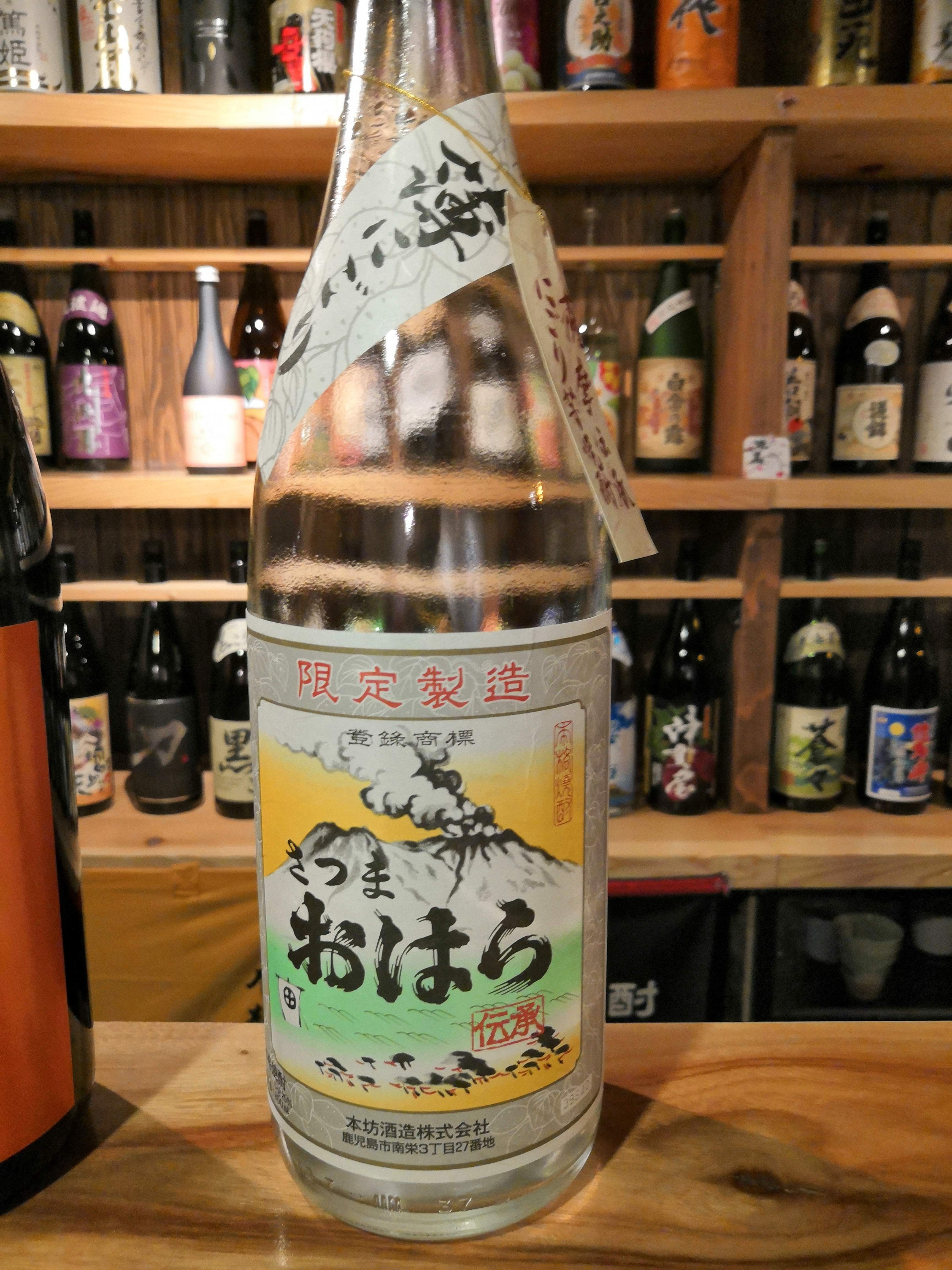
As explained in the last post, shochu is a distilled alcohol made from rice, barley, etc. It’s like whiskey, brandy or ram. Actually, more than 50 ingredients are permitted by Japanese government as ingredients for Shochu (authentic shochu has such restriction for ingredients, every ingredients are permitted for other type of shochu), and the number of permitted ingredients are increasing every year.
In this post, You will learn the things like : (sorry, but 5 and 6 are to be written next time!)
In comparison to fermented alcohol, the history of distilled alcohol is short. This is because it needs the technique for distillation.
China might be the first country which enjoyed distilled alcohol. Distilled alcohol in China has been known since at least 13th century.
A still is invented around 3000 B.C. in Mesopotamian period, however, distilled alcohol has been regarded as a medicine in Europe until 16th century. From Mesopotamia, a still was spread out to the world, as it was important for alchemy.
Shochu is said to have came from Thailand to Okinawa, a southern island of Japan around 14th Century. Some believe that it came from Korea to Iki island, a small island in Nagasaki prefecture, Japan as a form of Koryo liquor. (Iki is also famous for Iki-Shochu, and it is one of four Shochus listed in GI, Geographical indication. Scotch whiskey is also listed in GI).
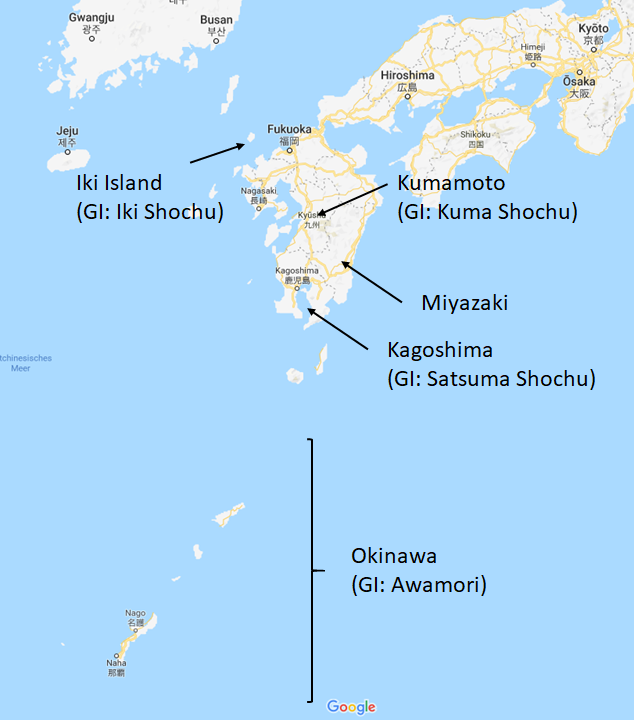
It is said that shochu arrived at Kagoshima around 16th century, and after that, it was spread to Kumamoto and Miyazaki. Around 17th century, people started making Shochu with local ingredients in each region. Issho-bin(一升瓶), a large 1.8 liter bottle for Sake or Shochu, became popular around 1910-1930.
There are some kinds of shochus including koshu shochu(甲種焼酎, lit. class A shochu) and otsushu shoshu(乙種焼酎, lit. class B shochu). Actually, otsushu shochu(class B) is more dedicated one than koshu shochu(class A), and koshu shochu is produced with automated process. In the world of shochu, class A or B is just for classification, and not for the quality. There is honkaku shochu(本格焼酎, lit. authentic shochu) as well, in the category of otsushu shochu.
One of the special thing about shochu is the use of mold called Koji-kin. Barley is sprouted to make a molt when making a whiskey or beer. Molt has an enzyme for degradation of a starch(a big molecule) into glucose(a smaller molecule). Yeast can only process glucose to produce alcohol.
For degradation, Koji-kin, or mold is used in Shochu production. Mold can also degrade the starch in a barley. The usage of mold is necessary for Japanese food culture, although in Europe, it was not so popular, except for blue cheese. In Japan or other Asian countries, due to its humid weather, it has been easy to get moldy. Therefore, there are lots of foods which use mold in Asia. Soy sauce(醤油) or Miso(味噌), basic seasoning for Japanese cuisine, comes from Daizu-Koji(大豆麹, Mold is breed in soy).
Japanese Koji (barley, rice, etc. covered with Koji-kin: mold) is a bit different from other Asian countries. In Japan, mold is breed in each individual grain of cereals. This type of Koji utilized in Japan is called バラ麹(Bara-Koji: separated Koji), and only one kind of mold (more scientifically, Aspergillus species) is used. In China, Indonesia, Philippines and Thailand, barley or rice are crashed, and then the mold (mainly Rhizopus species) is spread out into its surface and breed. This kind of Koji is called mochi-Koji(餅麹).


These mold has a proteolytic enzyme which decomposes protein, in addition to amylase, which decomposes starch. Proteolytic enzyme produces amino acids and peptide, which contributes to the taste.
Following environment is required for breeding of mold.
Three different types of Koji-Kin are used for production of Shochu or Sake, as shown below.
| Scientific name (IRBN) | Note of Shochu made with each Koji | used for | |
| 白麹菌(Shiro-Koji Kin; lit.: white mold) | Aspergillus kawachii, a white color mutant of Kuro-Koji | soft sweet refreshing | Most of the shochu |
| 黒麹菌(Kuro-Koji Kin; lit.: black mold) | Aspergillus niger(in the past), Aspergillus awamori (or Aspergillus luxhuensis), Aspergillus usami | thick(flavour and taste of ingredients are strengthened) rich taste crisp finish mellow | Awamori Some Shochu |
| 黄麹菌(Ki-Koji Kin: lit.: yellow mold) | Aspergillus oryzae | fruity refreshing | Sake some Shochu |
White mold has higher fecundity than black mold. Both write and black mold produces large amount of citric acid, which prevents fungi from propagating. White mold produces more citric acid. This enables Shochu distilleries do fermentation in an open room in Kyushu and Okinawa, where is known for high humidity and temperature.
White mold decomposes starch more, and therefore, it produces more softness and sweetness in taste. Black mold is non-perishable. Both white and black mold produces enzymes which decomposes dietary fiber. This feature of black and white mold is also feasible for the production of potato Shochu.
Yellow mold does not produce citric acid, and compared to other mold, more amylase is produced.
Manufacturing process of Shochu can be divided into mainly five parts, i.e. Seigiku(koji making, 製麹), Ichiji-shikomi (first preparation, 一次仕込み), Niji-shikomi (second preparation, 二次仕込み), distillation and aging. Both Ichiji shikomi and Niji shikomi are fermentation process. Some reader may think that one fermentation process is enough, but the advantages of these process is that molds and yeasts get used to the environment slowly. More taste of ingredients and mold remains in final product in this way. Also, as I explain below, there is a different function for Ichiji shikomi and Niji shikomi. Awamori is an exceptional shochu, with only one fermentation process.
Koji is a mixture of mold and ingredient. Mold is bred in ingredients, by sowing ingredients with some Koji and mixing it properly. If rice is used for ingredients of Koji, it is called as Kome-koji(米麹, lit. rice Koji). Here, Kome-koji production process is explained, but the process is almost the same among each ingredients. As explained in previous section, Koji making corresponds to the production of malt from barley to make a fermentable sugar in beer or whiskey making.
To make Kome-koji(米麹), rice is first washed and soaked into water. Then to easily breed the mold, rice is steamed. The best condition for Kome-koji is the hard surface and soft inside (with enough water). The steamed rice then kept around 35-40 ℃, and mold is added in the rice. Bacterial thread of mold goes inside and get bred. After that, each grain of steamed rice should be made separated, which is a hard work. Mold helps starch be glucose which yeast can process(or “eat”).
Some distillery use barley as an ingredient, which is lead to be Mugi Koji(麦麹, lit. barley Koji). Imo-Koji(芋麹, lit. potato Koji) is used in few Shochu, because of the technological limitations. Potato has less starch to produce alcohol, and potato goes bad(rot) with not enough alcohol. In addition, potato gets harder when they are steamed, and mold hardly goes inside of potato. Kokubun shuzou distillery invented the technology to use potato as an ingredients. It was also difficult to make Soba-koji(蕎麦麹, lit. buckwheat Koji), as husk of buckwheat is too hard for bacterial thread of mold to get inside of buckwheat. The surface of steamed buckwheat (steaming is necessary to make mold grow) will get viscosity, which makes it difficult that mold adhere onto buckwheat. Takara shuzo distillery overcame this problem and now shochu with Soba-koji. The taste of shochu with some Kojis in comparison to the one with Kome koji is shown below.
Note that the ingredients of Koji and the type of shochu are not necessarily the same. Some barley shochu use koji with rice, and most of potato, buckwheat and other ingredients – Shochu use kome (rice) koji.
Koji is mixed with water and yeast in Ichiji-shikomi(first preparation). This mixture is called Ichiji-moromi(一次醪, first unrefined sake). The yeast is cultivated and glucose made by mold is fermented (in Ichiji-shikomi, 15 vol% of alcohol is produced). Citric acid is produced to prevent a rot of ingredients. This process takes 6-8 days, and during first preparation, temperature is kept around 25-30 ℃, the Ichiji-moromi(first unrefined sake) is properly mixed.
There is a special yeast for shochu called shochu yeast(焼酎酵母). Shochu yeast endures high temperature and high acidity. Also the yield is quite high. Some compounds related to shochu smells are made with yeast as well, the yeast is also important.
Niji shikomi is a process to add the main ingredient of shochu and additional water. In this process, the ingredient is fermented, and more alcohol is produced. This process gives Shochu more flavor. It normally takes 8-10 days.
There are two different methodology for fermentation.
The mixture made after fermentation is called Niji-moromi(二次醪, second unrefined sake).
There is two types of distillation method, and three types of still.
Below are the still used in distillation process for Shochu production. Only pod still (first two still) is permitted for authentic Shochu, or Honkaku Schochu(本格焼酎).

We can also divide the distillation method by the pressure, under which the second unrefined sake (Niji moromi) is distilled. Normal and reduced pressure are used for distillation of Shochu.
(I just write my personal note here. Unless you are in chemistry (or probably even if you are studying/have studied chemistry), you will get confused, please skip it if you don’t like it! ) I wrote it, but I’m still not convinced why the distillation under reduced pressure makes lighter taste. Normally, reduced pressure helps to survive the components which thermal decomposition is likely to occur. And the distillation with multiple components has very different behaviour than that with single component. Boiling point of ethanol-water azeotrope is lower (78.2 ℃) than that of water (100 ℃) or ethanol (78.3 ℃). With some other components, the boiling behaviour is much more complex. Perhaps any of reader has an idea for that? I’m not sure if I still need to think of it, as the taste is complex, and not many people (or none?) can expect the results of distillation under reduced/normal pressure with so many fractions (I guess there are over 200 different chemical components in shochu…).

Shochu making is almost finished now, but it is not completed(No worries, it is not mission impossible): the taste of distillate is too young (too sharp; not mild) as the structure of the liquid (or structure of water and ethanol) is not stabilised (Unstabilised ethanol gives a pungent taste to shochu). Therefore, it will be stored in jar/tank/cask below for at least a month. Some shochu are stored and aged in pot or cask, as whiskey distilleries do. The name “古酒(koshu, old sake)” is allowed if the content of aged shochu(>3 years) is more than 50 % compared to total. Therefore, if the new sake is blended into a koshu but still a content of aged shochu (>3 years) is more than 50 % to total, that sake would be called koshu. It is not so strict like whiskey.
After aging, unblended shochu are blended or water is added into it to adjust the taste to the best. Shochu is now bottled and sold.
Umm I wrote too much about shochu this time… Next time, I’ll write about the taste of shochu, difference of taste by the ingredients or process, and more!
Enjoy booze with knowing! Cheers!
Shochu(焼酎) and Soju(소주) are both distilled alcohol, with a different origin. Shochu is from Japan, and Soju is from Korea.


Shochu and Sake are totally different, Shochu has more alcohol with distillation, while Sake has lower alcohol and produced without distillation.
Japanese government admit Shochu makers to use more than 40 ingredients. Most famous ingredients are barley, rice and potato. On the other hand, Korean government does not admit rice as ingredients for Soju, as they are important food for Korean people (of course for Japanese people, too!).
Shochu is single distilled. Single distilled alcohol contains more chemicals (taste and smell) from its ingredients and therefore you can enjoy the taste of ingredients. Distillation is done under lower pressure or normal pressure. Lower pressure one has more light taste, as water or alcohol boil at lower temperature and it means lighter chemicals appear. Shochu distilled under normal pressure needs higher temperature for boiling, and heavy chemicals appear in distilled alcohol. Lighter chemicals give more smooth and light taste, which is easily drinkable. Heavy chemicals give heavier taste, giving shochu heavier texture and imposing/distinctive taste. Soju is distilled multiple times, and that leads to less chemicals for smell and taste in Soju.
Japan and Korea have some similarities for our culture, including drinks, however, the production of alcohol is different. Japanese people tend to enjoy the taste of ingredients itself. In Korea, there is a cocktail called ”
Somaek “, which mix Soju and Beer(maegju).
Enjoy alcohol with knowing! Cheers!
This is a first post for this blog. Let’s start with defining our interest – alcohol. This articles can include some technical terms. Leave a comment if you do not understand or have some criticism against theories described below, I am happy to answer all of the questions and I appreciate the constructive discussions 🙂 It would be very kind of you if you tell me a mistake in English or scientific fact, I am open to learn new things.
The first alcohol a mankind had was a mead. A man found a broken honeycomb while hunting around 14000 years ago. Rain water was contained in a honeycomb, and honey was fermented together with the water – this was a mead.
Claude Lévi-strauss, a French anthropologist, says “the invention of mead as a marker of the passage from nature to culture“.
Mead is important for cultural reasons. It is a first alcoholic drink. It is a first drink or food which is consumed for cultural reasons, rather than appetite. Invention of mead lead people to get drunk together with others and enjoy that moment. This extraordinary feeling of drunkenness strengthened the relationship between people, played an important role in beliefs and mythology.
Mead is very easy to produce, the ingredients is just water and honey. Normally, a honey has too much suger content which is harsh for microorganisms, owing to high osmotic pressure. With addition of water into honey, the suger concentration (or osmotic pressure) declines to the level where microorganism can live.
This easy production process of a mead lead people start producing fermented drinks themselves. People started adding some other ingredients and change the taste – that means mead is an origin or ancestor of all alcoholic drinks.
Let’s say we all know about alcohol, but how are they made? Production is the most taste-deciding process for alcohol, along with storing and serving method. But let’s discuss the details later and we see more fundamental thing here: How is alcohol produced?
Fermentation of barley, fruits, harb, etc. makes what we call “alcohol” or more accurately ethyl alcohol(Ethanol). It is a biochemical reaction by enzymes, or more specifically yeasts.This process is chemically written like
 2C2H5OH\ + 2CO2}}}”/>
This reaction is results of several biochemical reactions. The first reactions occurs in Glycolysis, a metabolic pathway and produce pyruvates from glucose with 10 step reaction. The Pyruvate produced is a core for every fermentation processes as well as energy production in our body – from Pyruvate, lactic acid is produced via lactic fermentation, ethyl alcohol is produced via alcohol fermentation, and huge energy (8 ATPs in total) is produced via TCA cycle in our body.
 2CH3COCOOH\ + 2ATP\ + 2NADH\ + 2H2O\ + 2H^+}}}”/>
After that, Pyruvate decarboxylase catalyses the decarboxylation of pyruvic acid to acetaldehyde and carbon dioxide in the cytoplasm of prokaryotes.
 CH3CHO\ + CO2}}}”/>
Finally, acetaldehyde is reduced by the electron of NADH (NADH is a material which transfers the electron in organisms), and ethanol is produced. This reaction is catalyzed by Alcohol dehydrogenase.
 C2H5OH\ + NAD^+}}}”/>
To make the last two reaction occur and produce ethanol, for most of the yeast, oxygen should not exist. However, yeast which are utilized often (Saccharomyces cerevisiae, S. pombe) are not affected by the existence of oxygen, so alcohol can be produced with proper culture conditions under aerobic conditions. Half of the measured suger content will be produced via fermentation with Saccharomyces cerevisiae.

Belgian Lambic beer uses a yeast from air, I am very interested in this beer, so I’ll have a research on it and its yeast, and share it later.
20 % of ethanol is absorbed in stomach, and other 80 % of ethanol is absorbed in small intestine. Ethanol absorbed will then enters into the bloodstream, entering water content of each tissue in our body, except for fat tissues. Ethanol is hydrophilic and fat tissue is hydrophobic, therefore ethanol does not go into fat tissue. By the way, muscles contains more water and then it’s more hydrophilic and absorbs ethanol. Person who has more muscles are less likely affected by alcohol. Therefore women, who tend to have more fat and less muscles tend to be susceptible to alcohol. Of course, there are other factors of this affect, like if a person has enough alcohol degrading enzyme or not which is shown below.
Alcohol primarily works on nerve cells in the brain. I don’t know much about it so let’s have a help from youtube videos!
From this video, we know there are a neuron transmitter called Glutamate for excitation and a neuron transmitter called Gaba for inhibition. And alcohol suppresses Glutamate transmission and enhances GABA transmission. How are they chemically happen? the answer is below.
https://www.therecoveryvillage.com/alcohol-abuse/alcohol-and-gaba/#gref, seen on 11.02.19.
The relationship between alcohol and GABA is somewhat complex, and in some ways, alcohol and GABA have similar effects on the brain. This is because alcohol is an agonist of GABA receptors. This means that alcohol binds to certain GABA receptors in the brain, where it replicates the activity of the GABA neurotransmitter. So, does alcohol increase GABA? No, alcohol doesn’t increase GABA, but it does act on the brain in a similar way.
For those who want to know more, I would recommend to read this article by Martin Davies.
J Psychiatry Neurosci. 2003 Jul; 28(4): 263–274.
After we get the funny and enjoyable effect from alcohol, degrading of alcohol should occur. An enzyme, alcohol dehydrogenase, strips electrons from ethanol to form Acetaldehyde (Unfortunately, ethanol itself is toxic in humans and many other animals. This enzyme generates aldehydes or ketones, which are more useful). Another enzyme called aldehyde dehydrogenase oxidize aldehydes to form acetic acid (vinegar). 90 % of ethanol are chemically degraded like this, 5 % of ethanol are exhaled by lungs, and other 5 % of ethanol are eliminated by kidney, in urine. An average person can eliminate 15 ml of alcohol per hour.
I think it’s enough for today. Let’s finish it. Tomorrow, I will have a research more on fermentation process, scientifically. I want to write more practical things, like chemicals connected to certain flavor and taste, etc. but you know, fundamentals are very important in science. After the production, I will write about the receptors of taste and science of taste perception. Umm, there are lots of science behind alcohol. It is interesting to enjoy alcohol scientifically. (I should admit that I sometimes just enjoy getting drunk though..) See you on next article!
 Alcohol Freak Engineer