This is a first post for this blog. Let’s start with defining our interest – alcohol. This articles can include some technical terms. Leave a comment if you do not understand or have some criticism against theories described below, I am happy to answer all of the questions and I appreciate the constructive discussions 🙂 It would be very kind of you if you tell me a mistake in English or scientific fact, I am open to learn new things.
History
The first alcohol a mankind had was a mead. A man found a broken honeycomb while hunting around 14000 years ago. Rain water was contained in a honeycomb, and honey was fermented together with the water – this was a mead.
Claude Lévi-strauss, a French anthropologist, says “the invention of mead as a marker of the passage from nature to culture“.
Mead is important for cultural reasons. It is a first alcoholic drink. It is a first drink or food which is consumed for cultural reasons, rather than appetite. Invention of mead lead people to get drunk together with others and enjoy that moment. This extraordinary feeling of drunkenness strengthened the relationship between people, played an important role in beliefs and mythology.
Mead is very easy to produce, the ingredients is just water and honey. Normally, a honey has too much suger content which is harsh for microorganisms, owing to high osmotic pressure. With addition of water into honey, the suger concentration (or osmotic pressure) declines to the level where microorganism can live.
This easy production process of a mead lead people start producing fermented drinks themselves. People started adding some other ingredients and change the taste – that means mead is an origin or ancestor of all alcoholic drinks.
Production
Let’s say we all know about alcohol, but how are they made? Production is the most taste-deciding process for alcohol, along with storing and serving method. But let’s discuss the details later and we see more fundamental thing here: How is alcohol produced?
Fermentation
Fermentation of barley, fruits, harb, etc. makes what we call “alcohol” or more accurately ethyl alcohol(Ethanol). It is a biochemical reaction by enzymes, or more specifically yeasts.This process is chemically written like
 2C2H5OH\ + 2CO2}}}”/>
This reaction is results of several biochemical reactions. The first reactions occurs in Glycolysis, a metabolic pathway and produce pyruvates from glucose with 10 step reaction. The Pyruvate produced is a core for every fermentation processes as well as energy production in our body – from Pyruvate, lactic acid is produced via lactic fermentation, ethyl alcohol is produced via alcohol fermentation, and huge energy (8 ATPs in total) is produced via TCA cycle in our body.
 2CH3COCOOH\ + 2ATP\ + 2NADH\ + 2H2O\ + 2H^+}}}”/>
After that, Pyruvate decarboxylase catalyses the decarboxylation of pyruvic acid to acetaldehyde and carbon dioxide in the cytoplasm of prokaryotes.
 CH3CHO\ + CO2}}}”/>
Finally, acetaldehyde is reduced by the electron of NADH (NADH is a material which transfers the electron in organisms), and ethanol is produced. This reaction is catalyzed by Alcohol dehydrogenase.
 C2H5OH\ + NAD^+}}}”/>
To make the last two reaction occur and produce ethanol, for most of the yeast, oxygen should not exist. However, yeast which are utilized often (Saccharomyces cerevisiae, S. pombe) are not affected by the existence of oxygen, so alcohol can be produced with proper culture conditions under aerobic conditions. Half of the measured suger content will be produced via fermentation with Saccharomyces cerevisiae.

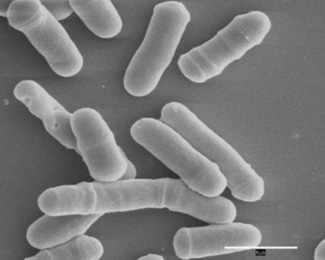
Belgian Lambic beer uses a yeast from air, I am very interested in this beer, so I’ll have a research on it and its yeast, and share it later.
How is Ethanol absorbed in our body?
20 % of ethanol is absorbed in stomach, and other 80 % of ethanol is absorbed in small intestine. Ethanol absorbed will then enters into the bloodstream, entering water content of each tissue in our body, except for fat tissues. Ethanol is hydrophilic and fat tissue is hydrophobic, therefore ethanol does not go into fat tissue. By the way, muscles contains more water and then it’s more hydrophilic and absorbs ethanol. Person who has more muscles are less likely affected by alcohol. Therefore women, who tend to have more fat and less muscles tend to be susceptible to alcohol. Of course, there are other factors of this affect, like if a person has enough alcohol degrading enzyme or not which is shown below.
Alcohol primarily works on nerve cells in the brain. I don’t know much about it so let’s have a help from youtube videos!
From this video, we know there are a neuron transmitter called Glutamate for excitation and a neuron transmitter called Gaba for inhibition. And alcohol suppresses Glutamate transmission and enhances GABA transmission. How are they chemically happen? the answer is below.
https://www.therecoveryvillage.com/alcohol-abuse/alcohol-and-gaba/#gref, seen on 11.02.19.
The relationship between alcohol and GABA is somewhat complex, and in some ways, alcohol and GABA have similar effects on the brain. This is because alcohol is an agonist of GABA receptors. This means that alcohol binds to certain GABA receptors in the brain, where it replicates the activity of the GABA neurotransmitter. So, does alcohol increase GABA? No, alcohol doesn’t increase GABA, but it does act on the brain in a similar way.
For those who want to know more, I would recommend to read this article by Martin Davies.
J Psychiatry Neurosci. 2003 Jul; 28(4): 263–274.
After we get the funny and enjoyable effect from alcohol, degrading of alcohol should occur. An enzyme, alcohol dehydrogenase, strips electrons from ethanol to form Acetaldehyde (Unfortunately, ethanol itself is toxic in humans and many other animals. This enzyme generates aldehydes or ketones, which are more useful). Another enzyme called aldehyde dehydrogenase oxidize aldehydes to form acetic acid (vinegar). 90 % of ethanol are chemically degraded like this, 5 % of ethanol are exhaled by lungs, and other 5 % of ethanol are eliminated by kidney, in urine. An average person can eliminate 15 ml of alcohol per hour.
I think it’s enough for today. Let’s finish it. Tomorrow, I will have a research more on fermentation process, scientifically. I want to write more practical things, like chemicals connected to certain flavor and taste, etc. but you know, fundamentals are very important in science. After the production, I will write about the receptors of taste and science of taste perception. Umm, there are lots of science behind alcohol. It is interesting to enjoy alcohol scientifically. (I should admit that I sometimes just enjoy getting drunk though..) See you on next article!

 Alcohol Freak Engineer